
Your Mirror’s Full of Shit!
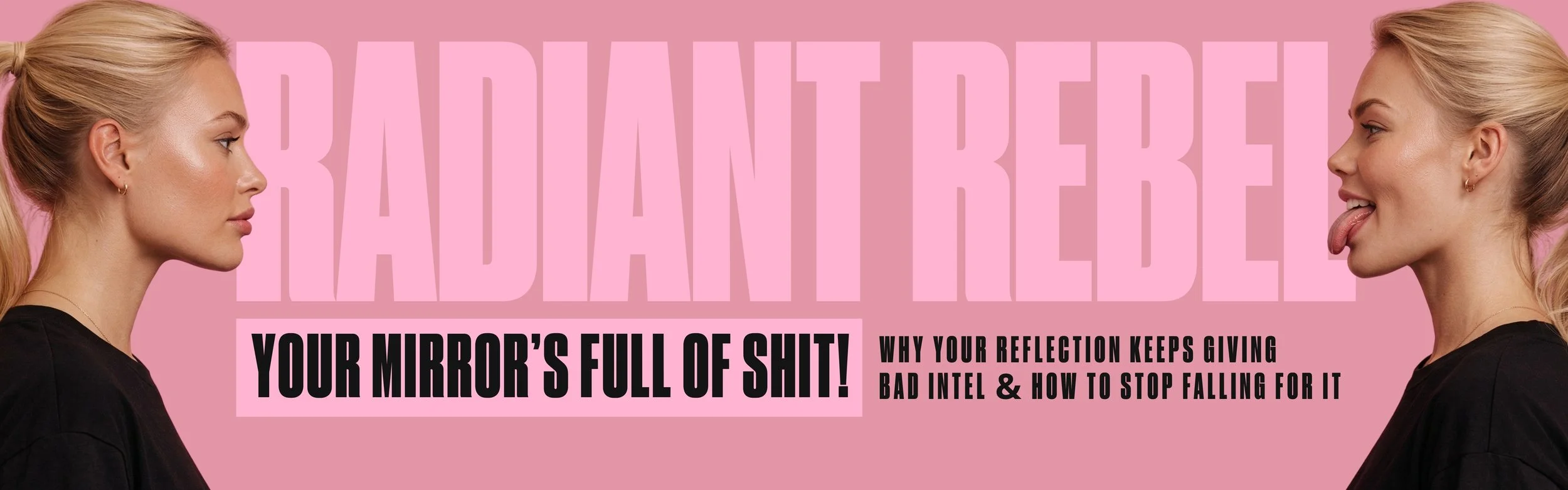
Why your reflection keeps giving bad intel & how to stop falling for it
Damn girl,
There are a lot of lies women get told, but one of the sneakiest is this: that your most critical view of yourself is the most accurate one.
It feels true. That’s the problem.
You look in the mirror and think, I look exhausted. Old. Puffy. Uneven. Weird in a way that no one else in the history of the world has ever looked weird before. And because the thought arrives quickly, and with the confidence of a man explaining crypto at dinner, it passes for fact.
But a lot of what we see in the mirror is not neutral. It’s filtered through memory, conditioning, insecurity, comparison, and whatever beauty panic trend the internet served us that week.
The good news is that because the voice in our head is learned, it can also be challenged and put in it’s place.
First of all, no one is born thinking their pores are a personal failure
The harsh voice is learned.
Nobody comes into the world looking into a reflective surface and thinking, my under-eyes are giving up. That comes later. Usually after years of absorbing comments, images, trends, beauty standards, and the general cultural suggestion that a woman’s face is a public project.
At some point, a lot of us stop simply having a face and start monitoring one.
That shift can happen early. A comment about weight. A joke about your nose. Watching adults criticize themselves in mirrors. A magazine cover. A bad photo. Puberty. Social media. Filters. Suddenly your face is not just your face. It’s something to assess.
That matters, because when a thought pattern is learned, it can start feeling incredibly natural. Natural does not mean accurate. It just means familiar.
Your brain loves repetition, even when the repetition is rude
This is where the psychology comes in, but don’t worry, I’m not about to turn this into a TED Talk with a ring light.
Your brain gets efficient at whatever it practices most.
If you’ve spent years scanning your reflection for what’s wrong, your mind gets very fast at finding flaws. It builds the habit. The pathway gets easier to access. That is one reason self-criticism can feel so automatic. It’s not necessarily that it’s true. It’s that the route is paved.
This is also the good news.
Because the brain can learn new routes too.
Not overnight. Not in one magical journal entry. Not because you whispered “I am enough” once while rage-moisturizing. But repetition does work both ways. If criticism can become habitual, kinder language can too.
Why you will probably never see yourself the way other people do
This is the part that gets me every time.
Most of us do not look at ourselves the way we look at other people. We zoom in. We freeze-frame. We catch ourselves mid-expression under bad lighting and then act like we’ve uncovered hard evidence.
Meanwhile, when we look at someone we love, we see the whole person.
We see expression. Energy. Warmth. Personality. The way their face changes when they laugh. The softness in them. The life in them.
We do not usually stare at a friend and think, devastating news about her forehead today.
But with ourselves, suddenly we’re forensic analysts.
That’s part of why old photos can be such a mind-bender. You find a picture from ten years ago, one you probably hated at the time, and think, Wait. She was gorgeous. Why was she so hard on herself?
Because she was seeing herself through pressure, not perspective.
And yes, the deeply rude part is that one day you may do the same thing with your face right now.
Today is the youngest you’ll ever be, which is frankly offensive, but also useful
I know. Horrible sentence. Unfortunately true.
But it does make a point.
The version of you that feels not good enough today may be the exact version you’ll one day look back on with tenderness. Which suggests the problem is not always your face. Sometimes it’s timing. Sometimes it’s the voice in your head. Sometimes it’s the fact that familiarity makes us blind.
So maybe the better question is not “Am I beautiful enough?”
Maybe it’s “Why am I speaking to myself like this while I’m in the middle of living my beautiful life?”
TRY ‘WOULD I SAY THIS TO A child’ test. It works alarmingly well.

A fast way to figure out whether your inner dialogue has gone off the rails is this:
Would I say this to a child?
Would you tell your daughter her face needs fixing before breakfast? Would you tell your younger self that her smile lines are a crisis? Would you train someone you love to scan herself for flaws before she is allowed to feel pretty?
Obviously not.
And yet many women do exactly that to themselves before 9 a.m.
This is not about becoming cheesy and calling yourself a goddess in the mirror if that makes you want to walk into traffic. It is just about basic decency.
If the voice in your head would be cruel coming out of someone else’s mouth, it’s still cruel when it comes out of your own.
Reframing is not delusion. It’s editing bad mental copy.
A lot of people hear “change the way you speak to yourself” and think it means lying.
It doesn’t.
It means being more accurate.
“I look disgusting” is not a fact. It’s a flare of emotion dressed up as observation.
“My skin looks tired today” is more accurate.
“I’m having a vulnerable day with my appearance” is more accurate.
“I am catastrophizing because the bathroom lighting is demonic” is, in many cases, extremely accurate.
Reframing is not about pretending you adore every inch of yourself at all times. It’s about taking the drama down a notch so your nervous system can stop acting like your face is an emergency.
Some examples:
Instead of: I look awful.
Try: I’m being hard on myself right now.
Instead of: My skin is a disaster.
Try: My skin is irritated. What would help?
Instead of: I hate how old I look.
Try: Aging is bringing something up for me today.
Instead of: I need to fix this.
Try: I want to care for myself.
That last one matters.
Fixing and caring are not the same thing.
This is where skincare can either help or make things worse
Skincare itself is not the problem. Obsession is the problem. Punishment is the problem. Using products like you’re in a feud with your own face is the problem.
Taking care of your skin can be a really lovely thing. Washing your face. Putting on something hydrating. Supporting your barrier. Drinking water. Sleeping. Feeding yourself properly. That can all come from self-respect.
It can also come from panic.
And the energy behind it matters more than people think.
There is a difference between “I’m taking care of myself” and “I cannot relax until I correct this.”
One feels grounding.
One feels like a hostage negotiation with your pores.
That’s why I think the healthiest approach to skincare is not correction. It’s relationship.
Not “How do I erase everything human from my face?”
More “What would support me today?”
That is a much saner beauty philosophy.
hyper-exposing every pore & FLAW is not the revolution people think it is
This might be the part where I lose a few people, but I stand by it.
I do not think the answer to perfection culture is swinging hard into aggressive rawness. The close-up fluorescent-light pore parade is not always liberation. Sometimes it’s just the same fixation in different branding.
One side says blur it all.
The other says expose it all.
Both can still come from disconnection. Both can still centre the face as a problem to manage. Both can still feel weirdly harsh.
I’m not saying authenticity is bad. I’m saying not everything has to become a performance. You do not need to hide every flaw. You also do not need to publicly interrogate your face in the name of being real.
There is a middle ground.
You are allowed to just have a face.
You are allowed to care for it without turning it into a statement piece.
Confidence is usually not about looking perfect. It’s about feeling safe.
This is worth saying because people talk about confidence like it’s all contour and positive thinking.
A lot of confidence is just what happens when you stop attacking yourself all day.
When your inner dialogue softens, your whole presence changes. Your face changes. Literally. People look different when they are not bracing against themselves. They seem more open, more alive, more attractive.
And yes, a smiling face is almost always more beautiful than a self-conscious one. Not in a pageant way. In a human way.
There is something magnetic about a person who feels at home in themselves.
That doesn’t come from scrutiny.
It comes from safety.
So how do you actually start changing this?
Not by becoming a different woman by Thursday.
Just by interrupting the pattern enough times that a new one can start.
A few places to begin:
Catch the sentence.
Pay attention to the first thing you say to yourself when you see your reflection.
Question the tone.
Ask, would I say this to someone I love?
Make it more accurate.
Replace dramatic, absolute language with something grounded.
Shift from fixing to caring.
Ask what support would look like today.
Stop treating every appearance thought like breaking news.
Not every bad angle deserves a committee meeting.
Over time, that matters. More than people think.
Final thought: the mirror is not always a reliable narrator
That doesn’t mean your face is fake. It means your interpretation of it is often loaded.
So the next time your reflection tries to ruin your day, maybe pause.
Maybe assume the mirror is not delivering objective truth from the heavens. Maybe it’s just echoing a very old script.
And maybe the work is not to force yourself to feel stunning every minute.
Maybe the work is simpler than that.
Talk to yourself with some respect. Care for yourself like you matter. Let your face be alive. Let it be expressive. Let it be human.
That is not giving up.
That is growing up.
And now you know.
xo Shelley
